
Reflections of shimmering oil lamps dance on the waters of ancient ghats, rivers echo with chants, drums reverberate through narrow alleyways, chariots roll like thunder on coastal roads, and kites stipple the winter skies. This is India, a country where festivals unfold to a rhythm, every season a celebration.
To follow these rhythms is to see a nation reveal itself in its most vivid form, through colour and prayer, food and ritual, dance and devotion.
The result is a living calendar of India’s biggest festivals, gloriously layered and deeply human. For the culturally curious traveller, this is your guide to immerse yourself in India’s soul, with insider context and practical advice.
But be warned, these community gatherings can be impossibly crowded.
Makar Sankranti – January
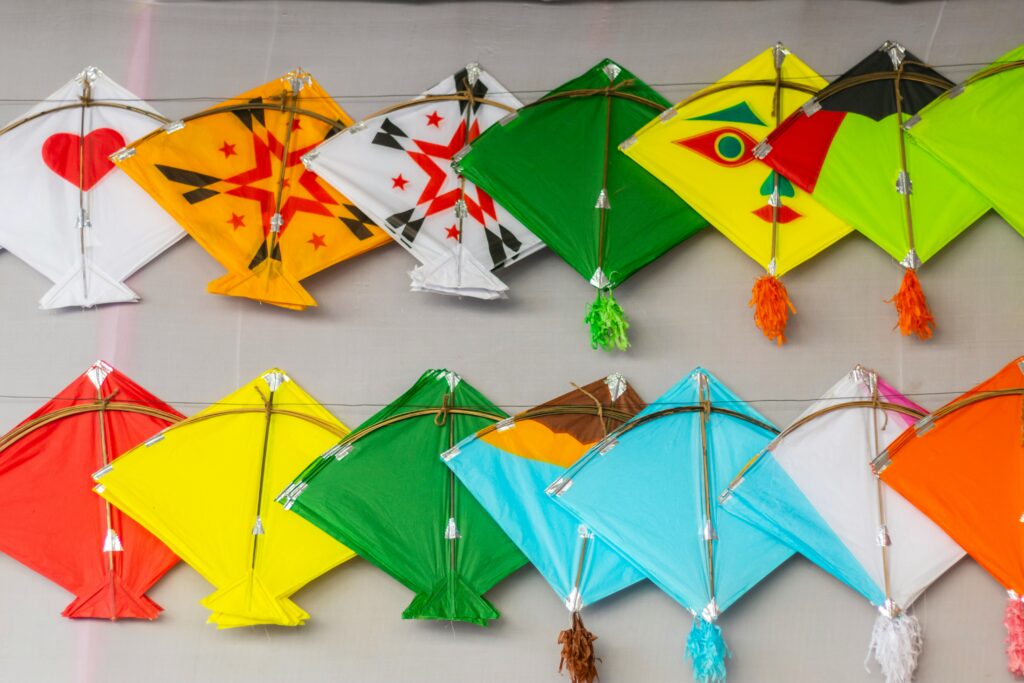
Makar Sankranti marks a rare moment in India’s festival calendar; it follows the solar rather than the lunar cycle, falling every year around January 14, when the sun enters Makar Rashi (Capricorn). It signals winter’s ebb, the start of the harvest season, and symbolically, the triumph of light over dark.
Across India, it takes on many names and forms. From Punjab’s Lohri bonfires and Assam’s Magh Bihu bamboo feasts to Bengal’s palm-scented Poush Parbon, Maharashtra’s sesame-sweet exchanges, and the tribal Tusu Parab songs of Jharkhand, they echo one truth. India greets the sun in its own dialect of gratitude.
In Gujarat, as the morning sun of Uttarayan sharpens over the desert, rooftops become launchpads for a thousand kites, bright battling shapes tugging against the winds. The old city of Ahmedabad echoes with the shouts of “kai po che”, the victory shout of a kite fight and on the Sabarmati Riverfront, kite flyers from around the world gather for the International Kite Festival.
Farther south, in Tamil Nadu, the same sun warms fields of rice and sugarcane. The air in the villages is perfumed with woodsmoke and jaggery as families celebrate Pongal, over four days of thanksgiving to the gods, the land, and the cattle that sustain them. In courtyards brushed clean at dawn, women trace white kolam patterns on the earth and set new clay pots on stoves, and as the sweet rice boils over, voices rise in union, “pongalo pongal”, a jubilant invocation of abundance.
Photographers will find endless colour and warmth. Cultural travellers and families will experience hospitality that feels at once both local and pan-Indian. Those who delight in the poetry of everyday life will love Pongal’s rural warmth, while those drawn to the thrill of celebration and competition will find energy in Gujarat’s open skies.
Sankranti falls annually around January 14-17. Both cities, Ahmedabad and Chennai, host large-scale events, so plan ahead. Pack cottons, sunscreen and a hat for long hours in the winter sun.
Holi – March
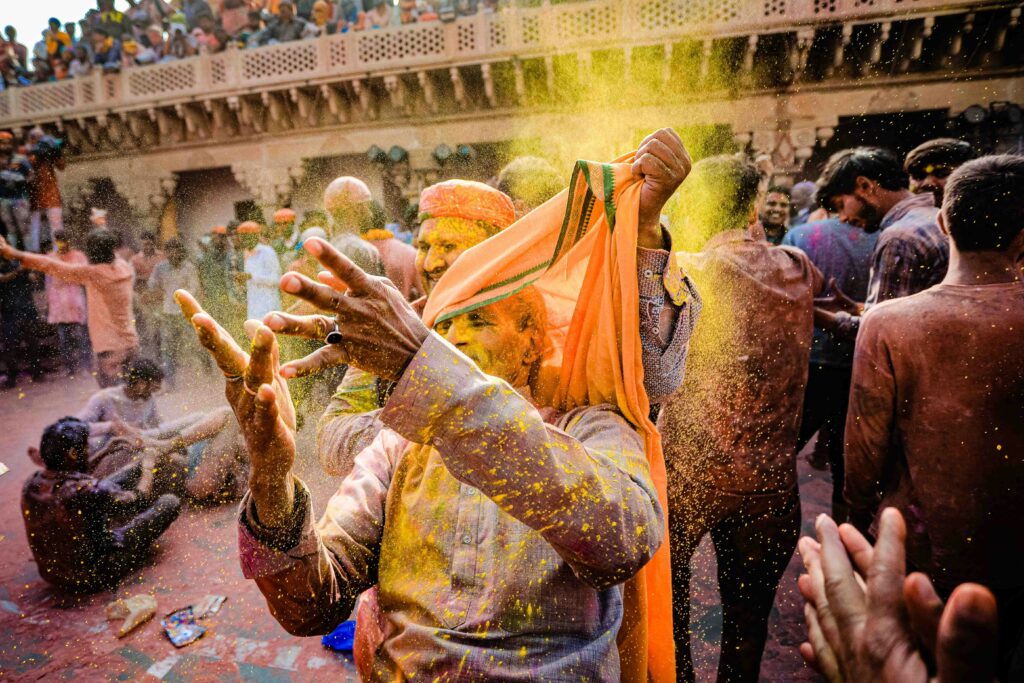
If Makar Sankranthi is a hymn to the sun, Holi is its laughter, India’s exuberant burst of colour, after the stillness of winter. Celebrated on the full moon day of Phalguna, usually in March, it marks both season and story. The return of spring, and the ancient tale of Prahalada’s faith that rose unscathed from fire. At its heart, Holi is a festival of renewal, when the old year’s hurts are washed away in pigment, music, and abandon.
Across the plains of North India, the dawn after Holika Dahan – when bonfires burn through the night to purge the world of evil – breaks in a swirl of colours. Streets turn into carnivals, clouds of magenta and emerald rise over temple courtyards, buckets of dyed water splash from rooftops, and drums beat a rhythm that erases age, class, and creed.
In Uttar Pradesh, in Mathura and Vrindavan, where the festival is believed to have begun with tales of Krishna and Radha, festivities go on for days. From the fragrant Phoolon ki Holi, where petals rain down inside the Banke Bihari Temple, to the spirited Lathmar Holi in Barsana, where women good-naturedly strike men with sticks, in a re-enactment of Krishna’s playful courtship.
Elsewhere, Holi takes on its own hues. Martial in Punjab’s Hola Mohalla at Anandpur Sahib, where Sikhs showcase their valour and discipline through mock battles and dazzling gatka displays. Regal in Rajasthan, where Jaipur’s palace courtyards and desert towns come alive with elephant parades and folk dances of whirling mirrored skirts and saffron turbans.
Holi is for travellers drawn to movement and metaphor. Photographers chasing motion, writers seeking story, friends eager to feel India’s warmth at its most free-spirited. The most iconic celebrations are in the temple towns of Uttar Pradesh, where heritage stays fill months in advance, so book early. Join community-organised or temple-led events, where the mood stays joyous and respectful. In cities like Delhi and Mumbai, curated gatherings offer a more contemporary and comfortable introduction to the festival.
Wherever you celebrate, step into the dance, taste the gujiya (a crispy pastry) still warm from the pan, and let the colours claim you. Wear clothes you can part with, oil your hair and skin to protect against dyes, and wrap your camera and phone in plastic.
Kumbh Mela: January – February
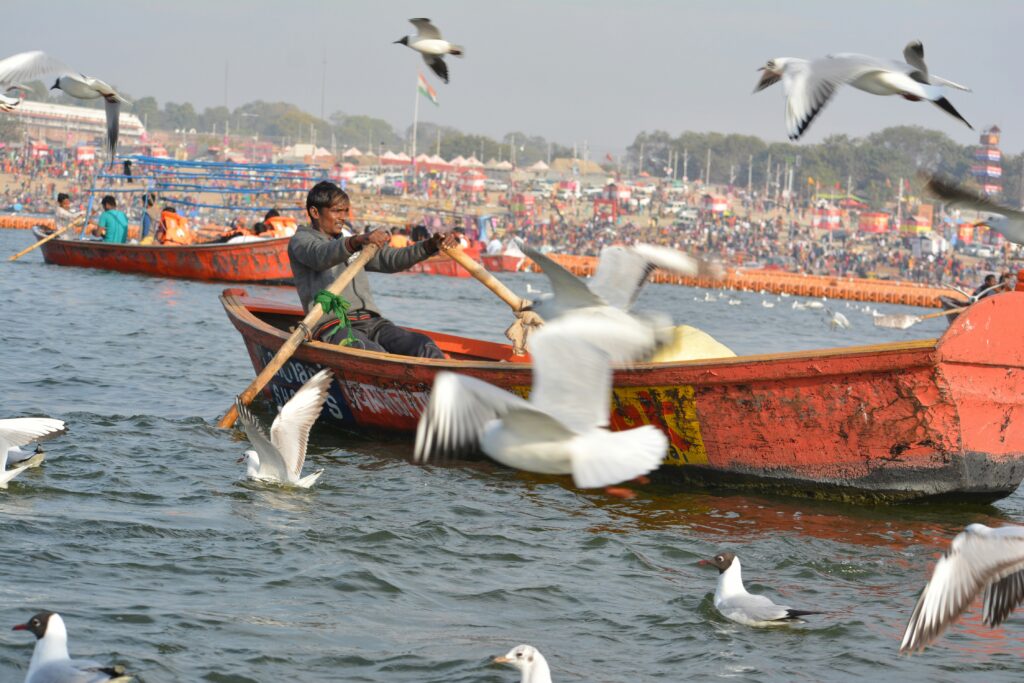
Where Holi cleanses in colour, the Kumbh Mela purifies in water. One bursts outward in joy, the other flows inward in belief. Between them lies India’s quiet conviction that renewal begins with surrender.
Born of the ancient legend of gods and demons churning the cosmic ocean for the nectar of immortality, the Kumbh marks the four places where those celestial drops are said to have touched the earth – Prayagraj, Haridwar, Ujjain, and Nashik. Each takes turns to host the Maha Kumbh Mela every twelve years. As the planets align, millions gather on the riverbanks to wash away lifetimes of karma. Recognised by UNESCO as part of the Intangible Cultural Heritage of Humanity, it is the world’s oldest and largest act of living faith, a gathering so huge it can be seen from space.
In Prayagraj, dawn comes softly over Triveni Sangam, the meeting point of the rivers Ganga, Yamuna and the mythical Saraswati. For a heartbeat, the mist holds still. Then a conch sounds, and the silence breaks with the deep clang of temple bells and the rising chant of mantras. From the horizon, processions of naga sadhus – ash-smeared ascetics crowned with marigolds – appear stepping into the river with a dignity that stills the crowd. It is not ‘spectacle’ but surrender.
Beyond the bathing ghats, a tented city sprawls across the floodplain, vast enough to have its own postal code and power grid. Within it, hermits and scholars, saints and sceptics, tea stalls and meditation halls coexist, the air humming with paradox – both chaos and communion.
The Kumbh Mela speaks to travellers drawn to the human story behind faith – anthropologists, photographers, spiritual seekers – those willing to embrace discomfort for the privilege of witnessing something timeless. Increasingly, curated eco-camps and tour operators offer guided stays, allowing visitors to experience the festival safely and respectfully.
Other more frequent Kumbh Melas, like the Ardh Kumbh, which returns every six years, and the Magh Kumbh Mela, which is an annual occurrence, are also culturally significant to the Hindus. Upcoming schedules and bathing dates are published on official state tourism portals before each edition.
Book early, travel light, follow advisories, and avoid the ghats during peak surges.
Jagannath Ratha Yatra: June – July
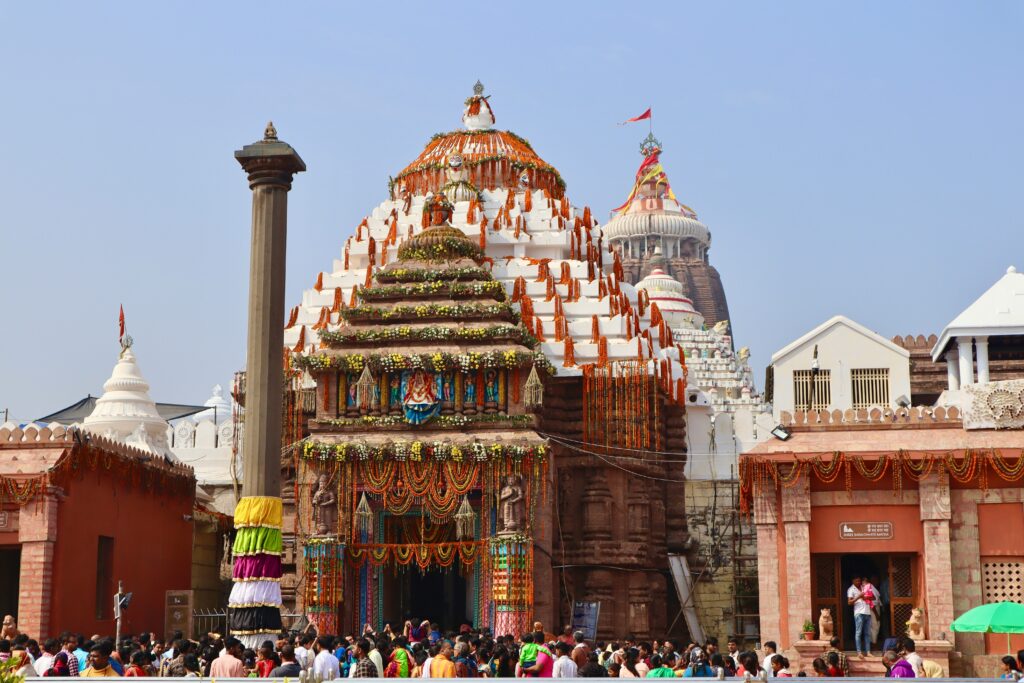
From the stillness of sacred waters, faith gathers momentum, and in the seaside town of Puri, it begins to move. Each summer, the gods leave their sanctum within the Jagannath Temple to journey among their people. The Ratha Yatra carries Jagannath, an incarnation of Vishnu, and his siblings Balabhadra and Subhadra, through the city on towering wooden chariots in a procession so grand it gave the English language the word juggernaut – a force impossible to resist.
The festival is an expression of India’s egalitarian theology that the divine is not remote, but moves within us and with us. It is also the country’s most democratic, where pilgrims or kings, believers or strangers, may grasp the rope and pull his chariot.
At dawn, the sound of gongs and conches rolls like surf over Puri’s Grand Road, connecting the Jagannath and Gundicha Temples. Built anew each year from sacred wood, the three chariots loom like temples on wheels, their red and yellow canopies rippling in the coastal wind, their wheels carved in mythic detail, each towering over forty feet high.
Then the rope tightens, thousands of hands grip it, and the great wheels begin to turn. The crowd surges forward as the chariots roll through a sea of flowers and prayers, drums and devotion. For devotees, to touch the rope is salvation. The idols rest for nine days at the Gundicha Temple, believed to be their maternal aunt’s home, before returning in the Bahuda Yatra.
In Hindu lore, Jagannatha is seen as a god who transcends the cycles of creation and dissolution, a divine presence said to remain even at the end of the world, carrying the promise of renewal beyond time.
Ratha Yatra is for travellers drawn to grandeur with gravitas – photographers, cultural enthusiasts, and seekers who wish to witness devotion as a collective choreography rather than a private rite. It is also the most accessible and emotionally inclusive experience for first-time spiritual travellers to the country.
Accommodation in Puri fills months in advance, while Bhubaneshwar offers upscale stays within driving distance. Arrive early to secure a safe vantage point along the route. Rooftops near the Singhadwara Gate offer sweeping views and can be pre-booked through local hotels. Follow crowd advisories, carry water, and respect cordoned zones.
Ganesh Chaturthi: August – September
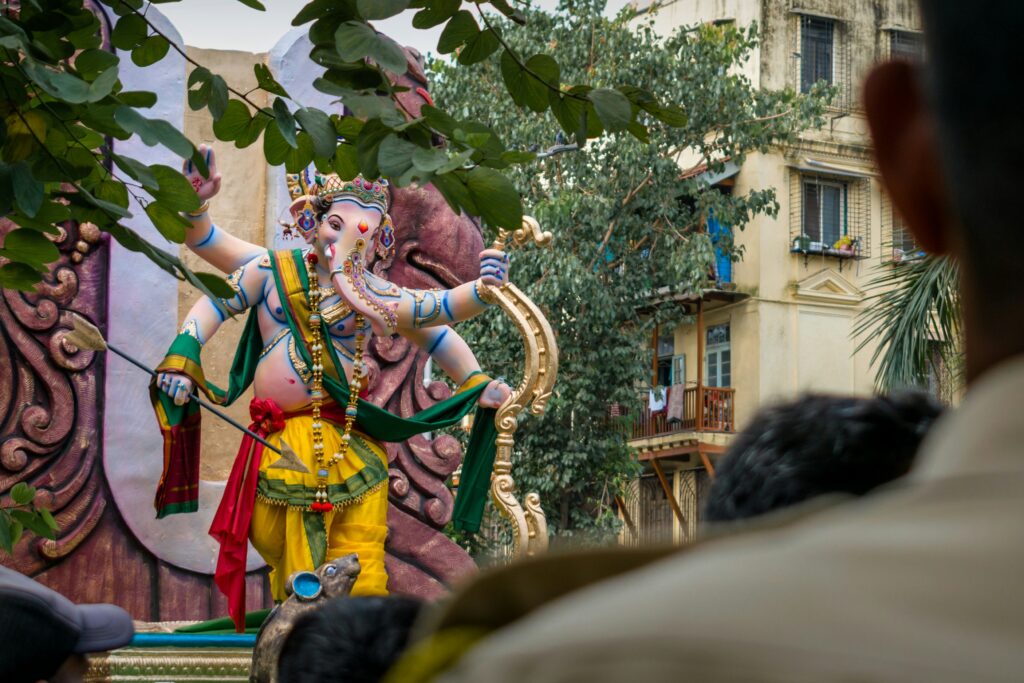
From the hand-carved chariots of Puri to the hand-painted idols of Mumbai, devotion moves through mediums, wood to clay, motion to stillness, in the festival of Ganesh Chaturthi.
Celebrated across India, from the coasts of Goa to the cities of Telangana, but nowhere more vibrantly than in Maharashtra. This ten-day festival marks the birthday of Ganesha, the elephant-headed god of beginnings and the remover of obstacles.
Across towns and cities, bamboo-latticed marigold-draped pandals (community pavilions) rise overnight, built and decorated by neighbourhood associations. Festivities begin quietly, with the installation of freshly painted idols surrounded by lamps and flowers. Children gather, hands folded in prayer, offering modaks (ghee-dipped sweet dumplings), said to be his favourite.
In Mumbai and Pune, the scale turns operatic. Majestic public installations, part sculpture, part theatre, shimmer under floodlights, each vying to outshine the next in artistry and story. The most revered among them, Lalbaugcha Raja, draws serpentine queues that wind through entire blocks, devotees waiting for hours not merely to see but to stand before him, to meet his gaze, murmur a wish, and feel for an instant the hush that cuts the city’s roar. Elsewhere, narrow lanes thrum with evening aartis (an offering of light) beneath tarpaulin roofs and laddoos blessed by Ganesha are auctioned off in spirited gestures of faith and fortune.
On the last day, the mood shifts to farewell, joyous and thunderous. Cymbals clash, saffron flags ripple, and dancers move in clouds of crimson powder. Idols hoisted high and borne through a tide of chant and confetti as cries of “Ganpati Bappa Morya, Pudhchya Varshi Lavkar Ya” (“O Lord Ganesha come again next year”) roll toward the sea. The most dramatic immersions, Visarjan, unfold along Juhu Beach and Girgaon Chowpatty, where waves catch the glow of a thousand lamps before carrying them back gently to the horizon, as if the sea itself were keeping the promise of his return.
For travellers, Ganesh Chaturthi offers one of India’s most cinematic windows into urban devotion, a living symphony of art, ritual, and community.
The festival days are best experienced along pandal-lined avenues in big cities or amid the gentler rhythm of small-town processions. To witness the visarjan, arrive early and follow advisories.
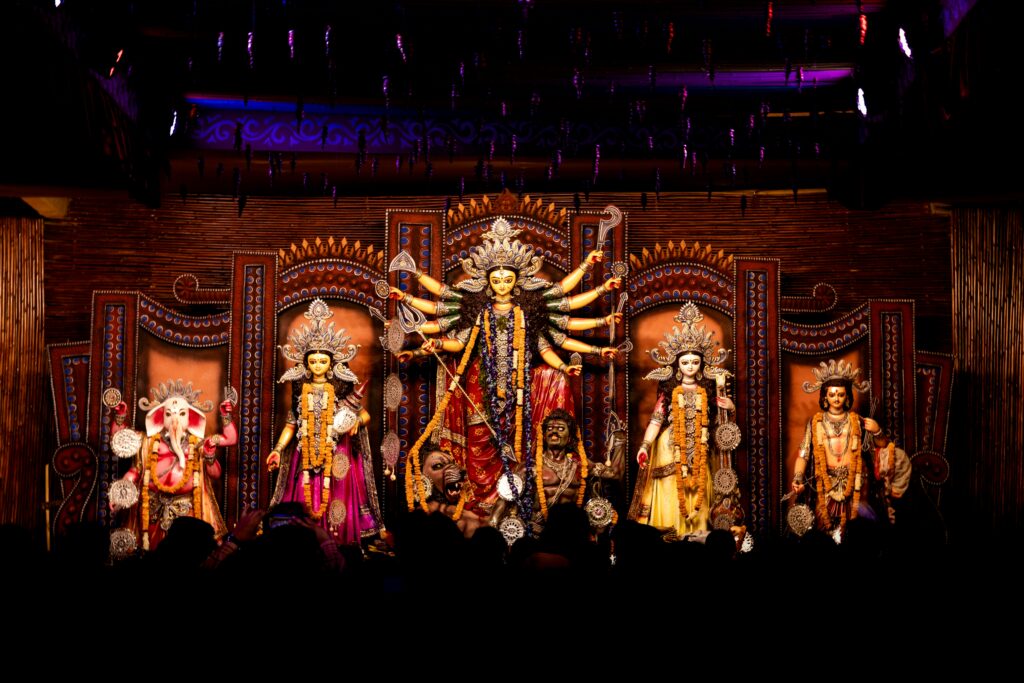
Devotion turns from earth to fire with Navratri and Durga Puja. Across India, this is the season of the goddess, fierce, protective, radiant. For nine nights and ten days, the divine feminine is worshipped as Durga or Shakti, who slays the demon Mahishasura and restores cosmic balance. The tenth day, Viajaya Dashami, marks her victory.
In the east, Kolkata’s Durga Puja, another UNESCO-tagged Indian festival, transforms the city into a living gallery, where sculptors and painters reimagine the goddess anew each year in bamboo, fabric and clay. Idols of the ten-armed goddess rise from clay on the banks of the Hooghly River before taking centre stage in pandals that rise like temples of art. Streets shimmer with light, dhak drums throb through humid evenings, and the air becomes thick with incense, shiuli blossoms, and frying beguni (an eggplant savoury). Crowds drift from one creation to the next, pandal-hopping as pilgrimage. On the final day, Sindhoor Khela paints the city in red as women in vermillion-bordered saris smear one another with sindhoor (a mercury red powder symbolic of marriage and auspiciousness) before the goddess is carried to the river, a farewell that feels like a promise.
In the west, Gujarat’s Garba nights unfold like a moving mandala, as light strikes the silver bangles of the dancers while their feet tap the earth in unison. The rhythm builds as wooden sticks clash in Dandiya Raas, joy spun into prayer. In the south, Mysuru glows in royal splendour as a golden chariot bearing the goddess rolls past its illuminated palace.
In the north, tradition turns to another tale of triumph, the Ramayana. Open-air Ram Leela performances in Delhi retell the epic of Ram’s victory over the demon Ravan, and as the effigies of Ravan smoulder against the autumn sky, the story arcs toward Diwali, when lamps will be lit to welcome Ram home.
Those who appreciate festivals that blur the line between art and atmosphere will find no season richer than this. Together, Durga Puja, Navratri and Dussehra reveal a country in full conversation with its gods through art, dance, and fire.
Hotels in Kolkata, Ahmedabad, and Mysuru fill to capacity weeks in advance. Book early. Dress modestly and wear comfortable footwear. If you want to revel in the pandals at a more leisurely pace, visit in the early evening.
Diwali: October – November
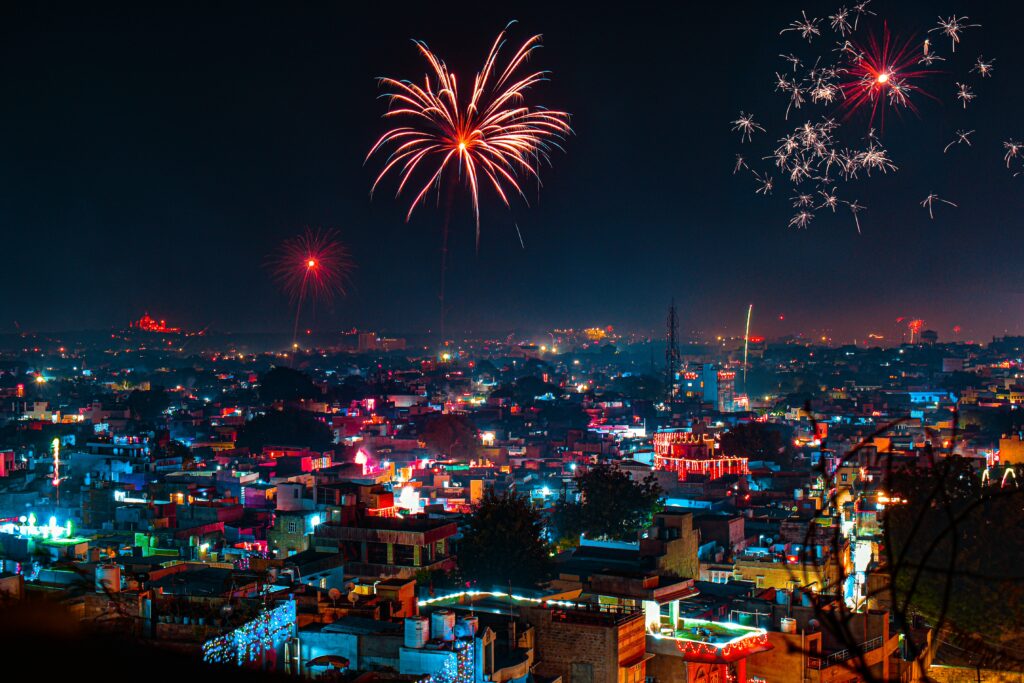
If Dussehra is the blaze of victory, Diwali is its afterglow, a night when darkness itself becomes canvas. Oil lamps glitter like stars in a constellation, across the country, in courtyards, on balconies, and along its ghats and rivers.
Diwali carries many stories with one meaning: that of the light of hope, renewal and the human spirit. In the north, it marks Ram’s return to Ayodhya after vanquishing Ravan, in the south, it recalls Krishna’s victory over the demon Narakasura, and across India, Lakshmi, the goddess of wealth and fortune, is welcomed into homes.
The festival unfolds over five days. Dhanteras, the auspicious beginning when new metal and gold are bought to invite prosperity, Naraka Chaturdasi, the cleansing dawn, Amavasya, the moonless Diwali night, Govardhan Puja, a day of gratitude and Bhai Dooj, to honour the bond between siblings.
On Diwali night, the senses quicken – silks rustle, lamps flicker, and every shadow seems to soften in the glow. In Varanasi, thousands of earthen lamps float down the Ganga, their reflections trembling like starlight on water as priests lift aartis to the sacred river. In Ayodhya and Udaipur, grand public displays draw visitors from across the world, but it is in the quieter lanes and ghats that its true essence shines.
In the cities, the mood turns symphonic, fireworks crown the skyline, children chase rockets through the streets, and families gather around platters of mithai – laddoos, barfis, jalebis – their sweetness laced with silver leaf and saffron. Doors are left open so Lakshmi may enter, and neighbours trade sweets in gestures of shared warmth. In the villages, clay diyas (oil lamps) line mud walls, their flames mirrored in brass utensils polished bright for the goddess’s arrival. For many, the night stretches into dawn over card games, laughter, and shared stories, as the thrum of fireworks and music slowly fades into the first call of morning.
For travellers drawn to myth and meaning, Diwali is India at its most luminous, where an act of faith becomes memory and joy turns into belonging.
Dress festive, yet modest, carry small gifts if visiting homes and observe the local firework curfews.