
Ahh, the Maldives, one of the most beautiful destinations in the world, especially from above, when its more than 1,000 idyllic atolls, each fringed by vibrant coral reefs and topped with swaying palm trees, many with chains of indulgent overwater bungalows branching out into the ocean, appear like green emeralds cast across turquoise sheets.
While the many resorts of the Maldives are each breathtaking in their own right, there’s nothing like seeing the archipelago from the window of a seaplane. In fact, due to logistics, remote destinations and curfews, this is the first vista that many visitors to the Indian Ocean destination encounter as seaplanes offer vital and convenient access to faraway atolls and postcard-perfect island escapes. Whether you’re a first timer or a Maldives regular, a solo traveller or a family on an adventure, a Maldives seaplane flight, and taking off and landing on water, is an iconic part of travel to this remarkable island nation.
I’ve been fortunate to have taken almost 50 seaplane flights in the Maldives over the past three decades, and in this feature I’ll guide you through the booking and boarding process of the Maldives’ expansive seaplane fleet, from luggage allowances to flight timings, give you a sense of what the experience of flying between islands and landing on water is really like, and suggest how to prepare for your own flight. Now, all you have to do is sit back and prepare for your own Maldives seaplane adventure.
How Seaplane Transfers in the Maldives Work
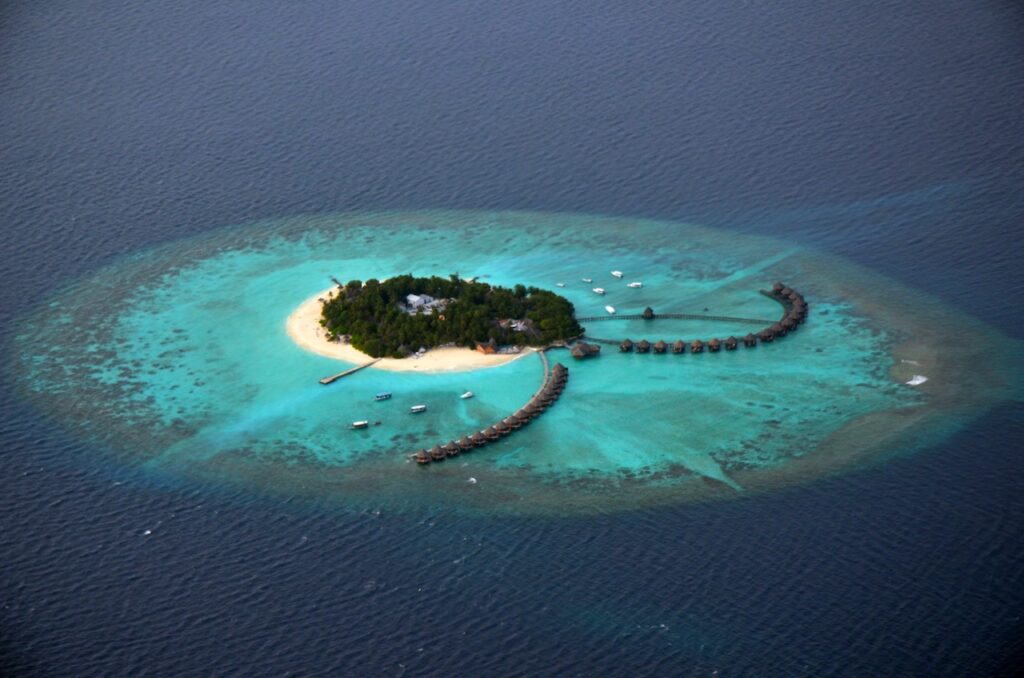
More than just an adventurous luxury, seaplanes are the workhorses of the Maldives, delivering travellers and supplies across this expansive archipelago.
Choosing the Right Transfer for Your Island Escape
Beyond the IG videos and resort reviews, one of the most important considerations when choosing a resort in the Maldives is access; a nighttime curfew on seaplanes means you need to consider what time your international flight arrives and which of the three ways you’ll then take to reach your resort.
Of the country’s approximately 110 island resorts, two dozen or so are located close enough to Velana International Airport, the main gateway to the Maldives, located in the Malé Atoll to be accessed via speedboat (usually within 40 minutes), which means that even if you do arrive after the seaplane curfew has begun, you’ll quickly be whisked away by resort boat. Some of my favourite resorts within easy reach of the airport by resort boat include:
- Naladhu Private Island,
- Gili Lankanfushi,
- Adaaran Select Hudhuran Fushi, and
- Four Seasons Resort Maldives at Kuda Huraa.
An alternative is taking a domestic flight with Maldivian or Villa Air to get within speedboat distance to your hotel. There are several domestic airports spread out the length of the Maldives (a nation that runs 871 kilometres north to south) and flights (often less than an hour in duration) to these airports still operate after dark, offering you an alternative to the resorts near the airport or a night at the airport hotel.
However, many travellers time their flight and itinerary to include an exhilarating seaplane flight, either one way or round trip, as they offer seamless, usually direct, extremely safe and convenient services and an unforgettable way to arrive in paradise.
There are presently three seaplane companies operating in the Maldives: Trans Maldivian Airways (TMA) is the world’s largest seaplane operator, serving over 80 resorts with its fleet of over 80 de Havilland DHC-6 Twin Otter aircraft (seating 10-15 passengers plus 2-3 crew); while Manta Air and Maldivian, which also operate Twin Otters, also offer services to selected atolls. Don’t be fooled by the casual attitude of the crew and pilots who prefer to fly barefoot; all three airlines have an impeccable safety record and the seaplane fleets are well maintained.
Flights typically take around 30-45 minutes (although flights to some of the more remote resorts, like Cheval Blanc Randheli, can take an hour), depending on the resort you’re flying to, with round-trip tickets costing US$400-600 per person. As you can’t really book seaplane seats yourself (unless you’re chartering a plane), most resorts offer special packages that also include seaplane flights, as it’s the only practical way for their guests to arrive and depart.
In fact, many resorts and resort groups, including Cheval Blanc, Four Seasons, and Soneva, have their own branded seaplanes, some of which are very luxurious, and which are operated by one of the airlines above. These aircraft are dedicated to their own resort guests, ensuring as seamless a transfer as a luxury bus charter (albeit a lot more exciting).
To meet your seaplane is also a seamless experience. Resort ambassadors will be waiting for you at arrivals at the international airport and within minutes, your luggage will be weighed and you’ll be in your transport – a mini bus for some resorts, a luxury SUV for others – on your way around the runway to the modern (and brand new) Noovilu Seaplane Terminal.
Here, many resort brands like Anantara, Six Senses and Heritence have their own luxurious airport lounges (the lounge for Heritence, for example, includes complimentary massages, high-speed Wi-Fi, shower suites and a hot and cold buffet). When it’s your time to fly, more ambassadors will guide you down to the departure lounges, where airline staff will brief you before walking you out to the rows of buzzing seaplanes waiting for guests. The process has been perfected over decades of tourism and you’ll quickly be on your way.
Timing Your Arrival — Seaplane Schedules and Curfews Explained
As I mentioned earlier, seaplanes don’t fly when it’s dark, meaning the arrival time of your international flight is pretty important. However, the resorts and the seaplane operators know the flight times and will make provisions that will get you to your resort as quickly as possible.
The reason for the lavish lounges at the seaplane terminal is that not everyone arrives on the same international flight. While you might get lucky and leave pretty much straight away, you may have to wait an hour or two until your seaplane is assigned and ready to fly (hence the free massages). Scheduled seaplane services begin at dawn (so if you do opt for the airport hotel, expect an early start the next morning) and continue until around 5.30 pm, with many planes finishing their last run at distant resorts so as to be in position to fly back as soon as the sun rises.
If you can, I’d suggest booking an international flight that arrives between 6 am and 3 pm in order to give yourself enough time to fly on to your resort (usually the last seaplane out of Malé is at 4 pm). Alternatively, if you can’t do that (and many flights that come from Asia do arrive after the curfew), you can spend a couple of nights at a resort in the Malé Atoll before moving on to a more distant property, or simply overnight at the airport’s Hulhule Island Hotel is the most convenient but there are many other options on the newly developed island of Hulhumalé, which is connected to the airport via a causeway.
The Airport and Pre-Flight Experience
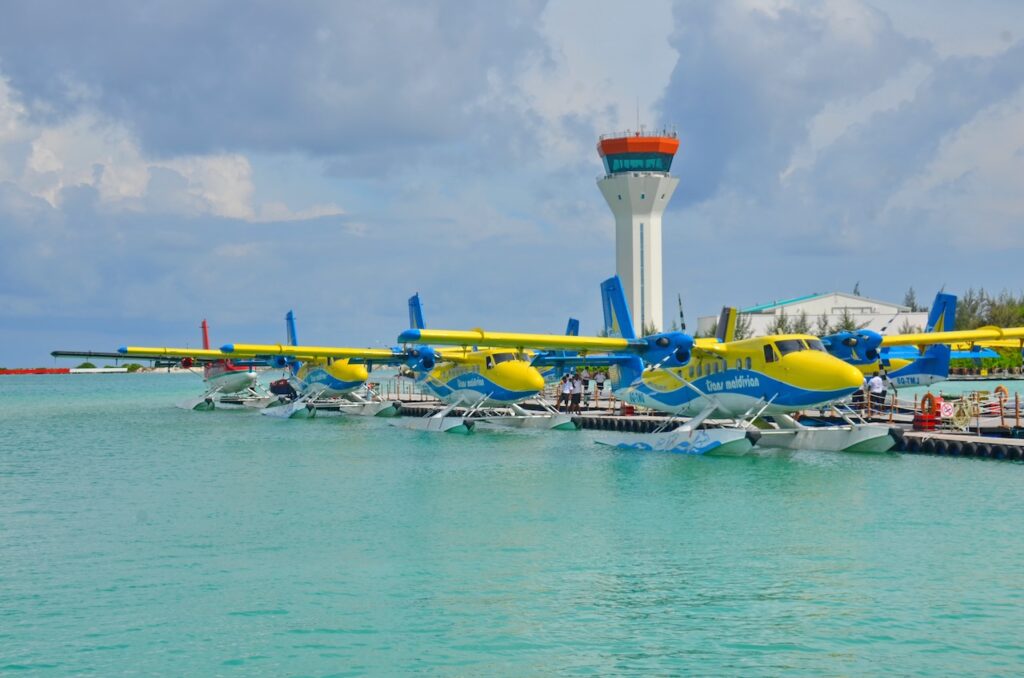
Things are distinctly more luxurious than they once were. Today’s seaplane travellers depart from a state-of-the-art dedicated terminal, complete with luxury lounges and modern facilities.
Inside the Seaplane Terminal
So when you arrive on your international flight and make your way through immigration and customs, look out for ambassadors holding signboards for your hotel (if you don’t find them immediately, you’ll find several dozen stands, each staffed by resort personnel that can help you).
These arrival ambassadors will quickly whisk you across to the check-in counters for the seaplane operators, where your check-in luggage (commonly limited to 20 kg so be sure to check your ticket before you depart for the Maldives as you might be charged for excess luggage), your carry-on bag (which is restricted in size as it goes at the back of the passenger cabin) and sometimes you will be weighed.
Then your check-in luggage goes in the back of a van (bags are thoroughly tagged, just like major airlines), to be taken directly to the seaplane, while you make your way to a mini bus or transfer car for the five-minute drive to the other side of the airport and the seaplane terminal.
As I mentioned, many resorts have their own dedicated lounges for seaplane passengers, some with balconies from which you can watch seaplanes arrive and depart. Even if your resort doesn’t have its own lounge, passengers flying with TMA often have access to the Coral Lounge or can wait in the public area, which has small cafes and shops, until it’s time to fly. Then, you’ll be guided onto the small departure lounges, which are dedicated to a specific seaplane, and then directly to your particular aircraft.
You will typically not have to wait more than two hours (and often far less) in the seaplane terminal as flights to even remote resorts run several times a day, depending on the season and arrival numbers.
Boarding Your Seaplane
As I mentioned above, the final step on dry land is the walk down the floating docks, which will be buzzing with seaplanes arriving and departing. Your airline guide will lead you directly to your seaplane, where your luggage will be loaded into the cargo area.
I suggest getting anything you need out of your carry-on, from a bottle of water to those all-important noise reduction headphones and cameras, before you board the plane, as those Twin Otters are pretty tiny inside and cabin luggage will often be taken from you and placed at the rear of the cabin and won’t be accessible during the flight.
All of the seaplane operators have free-seating policies but expect most flights to run fully loaded so once you step onboard, grab a seat (window seats are obviously most popular but with a 1-2 configuration, more travellers have windows than don’t), fasten your seatbelt and pay attention to the (very brief) safety briefing, often given by one of the two pilots from the cockpit. Don’t expect much in the way of creature comforts – there’s no in-flight movie (or any entertainment for that matter), and no AC, only a couple of well-intentioned fans. Seats are all pretty basic and the cabin can get hot, so I’d dress for the tropics, download Netflix movies in advance and, if you’re someone who gets airsick, take your Dramamine back at the lounge.
The cockpits on the Twin Otter don’t have doors, so you’ll be able to see all the action as the crew prepares for the flight, taxis out of their berth, and takes off.
This is the best part, as you watch the pilots increase the throttles and the twin propellers roar into action. Within seconds, you’ll take to the air, the harbour racing away below and your first resorts already coming into view. Then it’s endless turquoise lagoons, vibrant coral reefs, white-sand cays, and luxurious resorts (look out, as some have branding specifically for seaplanes passing overhead).
Landing is pretty much the same – the descent is much shorter than on international flights as seaplanes typically fly below the clouds, and the first you’ll know that you’ve arrived is that the plane’s nose will tip down (don’t be alarmed, Twin Otters really want to fly and need to be coaxed into descending) and suddenly you are only feet above the tranquil lagoon and roaring to a halt.
If you’re looking for the best view in the plane, I’d aim for one of the rear seats, from which you’ll get a great view of the islands passing below without the propeller and wings getting in the way.
In the Air — What to Expect on a Seaplane in the Maldives

One of the best travel experiences on the planet, a seaplane flight in the Maldives is a must.
Inside the Cabin
Typically, the Twin Otters operated in the Maldives cater to 12-16 passengers (some branded by resorts cater to fewer – Cheval Blanc Randheli’s plane seats nine and features leather seats, entertainment iPads and chilled towels) and expect your plane to be full as most run at 90% loading.
As you might have gathered by now, these are effectively sea buses, so expect plenty of noise (bring earplugs or headphones), plenty of heat (no AC and only a couple of fans blowing hot air mean you might want to dress light (but modest as the Maldives is an Islamic country) and even bring a personal fan and a bottle of water), and simple seating in a 1-2 configuration. If your seaplane flight is early in the morning, you might even want to wear your swimwear underneath so you can hit the sea or the pool while you wait for your room to be ready.
There’s free seating, so if you’re travelling as a family, be sure to board together so you can sit close, while photographers might want to be first on board to get a window seat near the rear of the aircraft.
The views from your seaplane really put the whole experience into perspective. From the air, you’ll be able to see Malé, the tiny capital of the Maldives and a curious pint-sized island on which every square foot has been used. You’ll also see uninhabited islands, powder white sand banks ringed by turquoise lagoons, community islands punctuated by villages, and resorts with long chains or villas reaching out across the house reefs. The views are nothing short of magical.
If you’re lucky enough to get a direct service (and in my experience, that’s more than half the time), then your flight will be short but sweet. Even if you do need to make a stop or two along the way, the time on the water is short – the crew jumps to action, resort staff grab luggage, and before you know it, you’re taking off again. Most flights range from 30 to 45 minutes, making for a short but very scenic arrival or departure experience.
Arriving at Your Resort
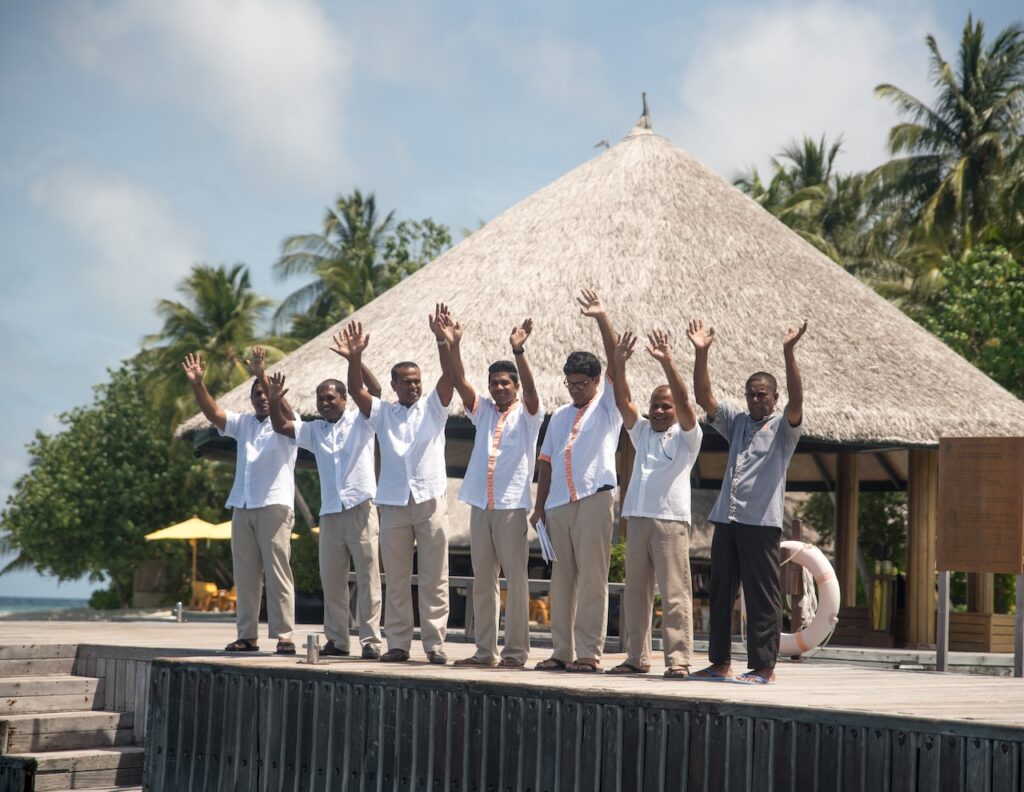
Once you arrive at your designated resort, it’s the same process, only in reverse. Step off the plane onto either a pier or a floating dock (depending on the resort and how many seaplanes are arriving) and your carry-on luggage will be passed down to you by the plane crew.
Your check-in luggage will be handled by the resort staff, who will be there waiting for you (often with a song and a dance) and will be whisked off to your beach or water villa to await your arrival after check-in. And as there is only one resort per island in the Maldives, there’s no confusion as to where you go next!
If you’re leaving the seaplane on a floating pontoon, a resort speedboat will be waiting to take you to land. Otherwise, expect a fleet of golf carts and smiling butlers who will guide you away from the pier and on to reception.
Practical Tips and FAQs for Seaplane Travel in the Maldives

Seaplanes are an exciting and convenient way to reach your resort. Here’s what to prepare to ensure your flight is comfortable.
Packing Smart for the Journey
As with international flights, luggage weight is important and it’s important to remember that while your business class ticket or loyalty status might get you additional check-in luggage on your international flight, you won’t have the same luxury on the seaplane (unless you’re prepared to pay).
Most tickets have a standard 20 kg allowance for check-in luggage and 5 kg for carry-on, and both are often weighed at check-in in Malé (but not usually on your return flight). Just remember, this is the Maldives, so grab your swimsuit and your flip-flops, but leave the tuxedos and dress clothes behind; no one really dresses up.
If you’re keen to get photos on your flight, remember there isn’t much in the way of room, so leave the telephoto lenses in your check-in bag and stick to cell phones or more mobile cameras like GoPros and DJI Pockets. These will get great results (so long as the weather behaves) and will help you capture the adventure of take-off and landing.
Wear light clothing as plane cabins are hot. Wear non-slip footwear like sandals or sneakers, pack a bottle of water (and take it out of your carry-on before boarding the plane), and remember those headphones and sunglasses. Sunscreen is also a good bet if you have sensitive skin.
Common Questions About Seaplanes in the Maldives
Are Seaplanes in the Maldives Safe?
Seaplanes in general are very safe and in the Maldives, they’re heavily regulated (even with those barefoot pilots). The airlines that operate the seaplanes are world-class and the pilots are extremely experienced at what they do, so while there might be a few bumps here and there, know that you’re in good hands.
What Happens if My Flight is Delayed by Weather?
Weather, as in any tropical destination, can be a consideration and occasionally seaplanes are delayed, either at Malé or at resorts, but this is usually only for a short period of time. The hotel staff booking your seaplane flight back to the international airport will always give you a sufficient time buffer between your arrival and your departing international flight.
What If I Arrive in Malé Before My International Flight?
One thing to note is that most international airline check-in counters only open three hours before departure, so if you’re departing on a night flight out of the Maldives and arrive back in Malé before the seaplane curfew, expect to spend a few hours in the airport’s arrival area.
There’s a Priority Pass lounge in the domestic terminal (you can also pay to access), and several restaurants open to the public before you enter security, but ensure your electronics are charged and you have everything you need for the duration.
Can I Explore Malé During a Long Layover?
If you have several hours, you can always leave your luggage with the seaplane operators and take one of the public boats over to explore the island of Malé – there’s a great museum and the fish markets are fascinating.
Can I Choose My Seaplane Time or Seat?
Seaplane scheduling is really out of your hands and while you might be able to request a specific time via your resort, most of the time it’s best to simply sit back and let the professionals time everything for you – this isn’t their first rodeo.
The Jetsetter Verdict: Why a Seaplane Flight is the Ultimate Maldives Experience
A Maldives seaplane flight is not only a convenient way to reach your luxury resort, but also a breathtaking experience in its own right, one that shows this world-class archipelago in a whole new way.
The excitement of taking off and landing on water, the spectacular views of tropical islands drifting by below, the convenience of seaplane transfers and lounges, and the thrill of arriving at your resort only hours after landing in the Maldives make this an iconic experience.
Like any flight, preparation is key. Keep an eye on your luggage weight, dress for the heat, know where your camera, phone and headphones are, and pay attention to instructions from resort staff and plane crew and you’ll have a brilliant time.
There are luxury resorts the world over, and destinations that rival the Maldives in terms of beauty. However, few experiences beat the thrill or convenience of a Maldives seaplane flight, one of the Indian Ocean’s truly unique travel experiences.